 Relay Resources
Disability is Not a Bad Word
 Relay Resources : Jan 10, 2025 9:00:00 AM
What comes to mind with the term “disabled”? Do you imagine someone in a wheelchair? What about “disability”? What images, associations, or thoughts...
For Black History Month this February, Relay Resources has been shining a light on some of the Black leaders who made important strides for the disability community, allowing organizations like Relay to thrive years later.
Our last post looked at the life of Lois Curtis, whose landmark case against the state of Georgia, Olmstead v. L.C., resulted in the Supreme Court ruling that people with disabilities have the right to live in settings that are unrestrictive — striking a major victory for disability rights.
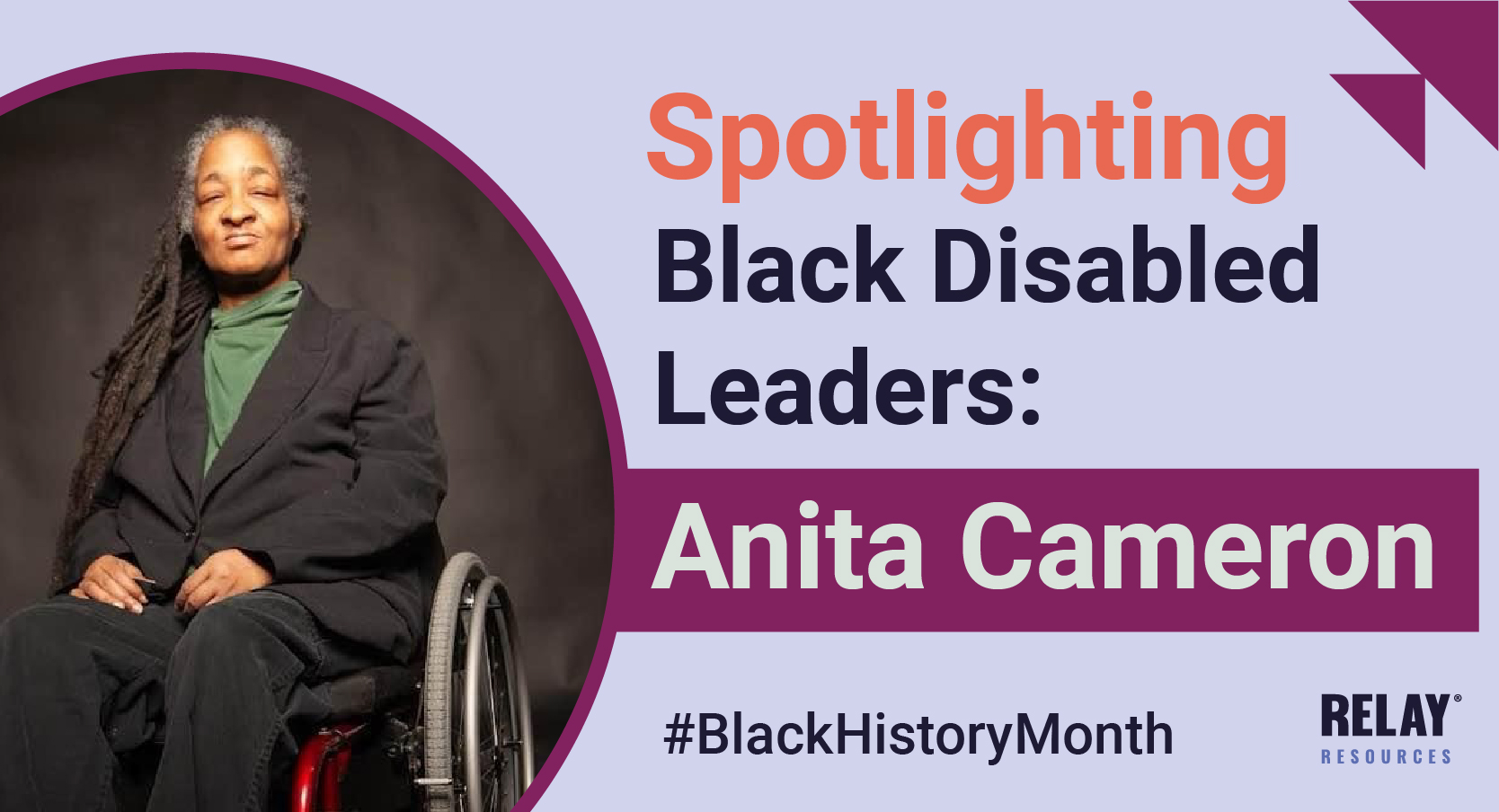
This time we’re sharing the story of Anita Cameron, a disability justice activist who played an integral role in getting the Americans with Disabilities Act passed and turned into law.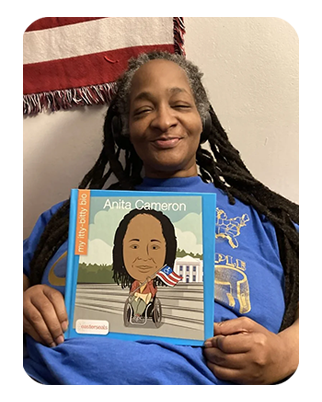
Cameron, who is blind, became involved with social justice in her teens; at age 21 she joined American Disabled for Accessible Public Transit (ADAPT), a grassroots disability rights group, and began fighting for public buses being wheelchair accessible, among other disability rights.
ADAPT led protests for bus lifts to be expanded around the country in the 1980s, holding events in Denver, Chicago, and beyond, and eventually suing the Chicago Transit Authority (CTA) for discrimination in 1986. The suit resulted in the CTA equipping more than 500 city buses with wheelchair lifts.
Seeking more change at the federal level, ADAPT and Cameron sought stricter laws that gave disabled people access not just to transportation, but to work, education, and housing — which would eventually result in the passing of the landmark Americans with Disabilities Act.
When she joined ADAPT in 1986, Cameron took part regularly in public calls for disability rights, being arrested 140 times in total for acts of non-civil disobedience.
 About her advocacy work during that time, Cameron told Able News, “We were putting sledgehammers to curbs all over Denver and Colorado Springs so folks using wheelchairs could get out and about … when things got desperate and something momentous had to be done, ADAPT, as the street fighters of the movement, led the effort.”
Another historic event was the Capitol Crawl on March 12, 1990, in which ADAPT led 500 marchers from the White House to the U.S. Capitol, with some protestors abandoning their wheelchairs to journey up the stairs on their hands and knees. Cameron was one of 104 people arrested in the Capitol Crawl protest.
She recalled to PBS about the event, “As I’m seeing the people around me, I'm like, ‘Whoa, we are doing it. We are really doing it. We’re, like, crawling into history.’”
Photo by Tom Olin.
The protest proved effective: More than four months later, on July 26, 1990, President George H. W. Bush signed the landmark Americans with Disabilities Act into law, protecting people with disabilities from discrimination.
Cameron continues her advocacy efforts, currently serving as Director of Minority Outreach for Not Dead Yet, a disability rights group that opposes the legalization of euthanasia and assisted suicide.
In the interview with Able News, which took place 35 years after the ADA’s passage in 2025, Cameron said about the act:
“The ADA means opportunities. I was able to get jobs outside the disability world. I’m able to use public transportation around the nation. I was able to request accommodations in school and graduate with another degree. Unlike my first time at university, disabled students were everywhere and everything was accessible, so we could get around the campus. Accommodations like audiobooks, note takers, and extra time for tests were always given.”
Relay Resources celebrates the work of Anita Cameron, whose advocacy resulted in a more accessible — and more inclusive — world. As an organization committed to advancing disability inclusion in the workplace, we benefit from the protections of the Americans with Disabilities Act every day. In helping to pass this essential piece of legislation, Anita Cameron is truly a figure worth celebrating.
 Relay Resources : Jan 10, 2025 9:00:00 AM
What comes to mind with the term “disabled”? Do you imagine someone in a wheelchair? What about “disability”? What images, associations, or thoughts...
 Relay Resources : Feb 26, 2026 1:17:35 PM
In celebration of February’s Black History Month, Relay Resources has been telling stories of Black disabled leaders who have made strides for the...
 Relay Resources : Dec 20, 2024 9:00:00 AM
As we look back on 2024, we at Relay Resources see our work as an effort to create the kind of world we want to see—one where people with...
5312 NE 148th Avenue
Portland, Oregon 97230