
Spotlighting Black Disabled Leaders: Haben Girma

Spotlighting Black Disabled Leaders: Haben Girma

Spotlighting Black Disabled Leaders: Haben Girma
5:10

In celebration of February’s Black History Month, Relay Resources has been telling stories of Black disabled leaders who have made strides for the rights of the disability community.

Last week we looked at the life of Anita Cameron, a blind disability justice activist whose tiresome work helped lead to the passage of the American with Disabilities Act (ADA). Before that we shined a light on Lois Curtis, whose landmark lawsuit Olmstead v. L.C. led to the Supreme Court ruling that disabled people could live where they choose. 

Haben Girma, Lawyer and Advocate

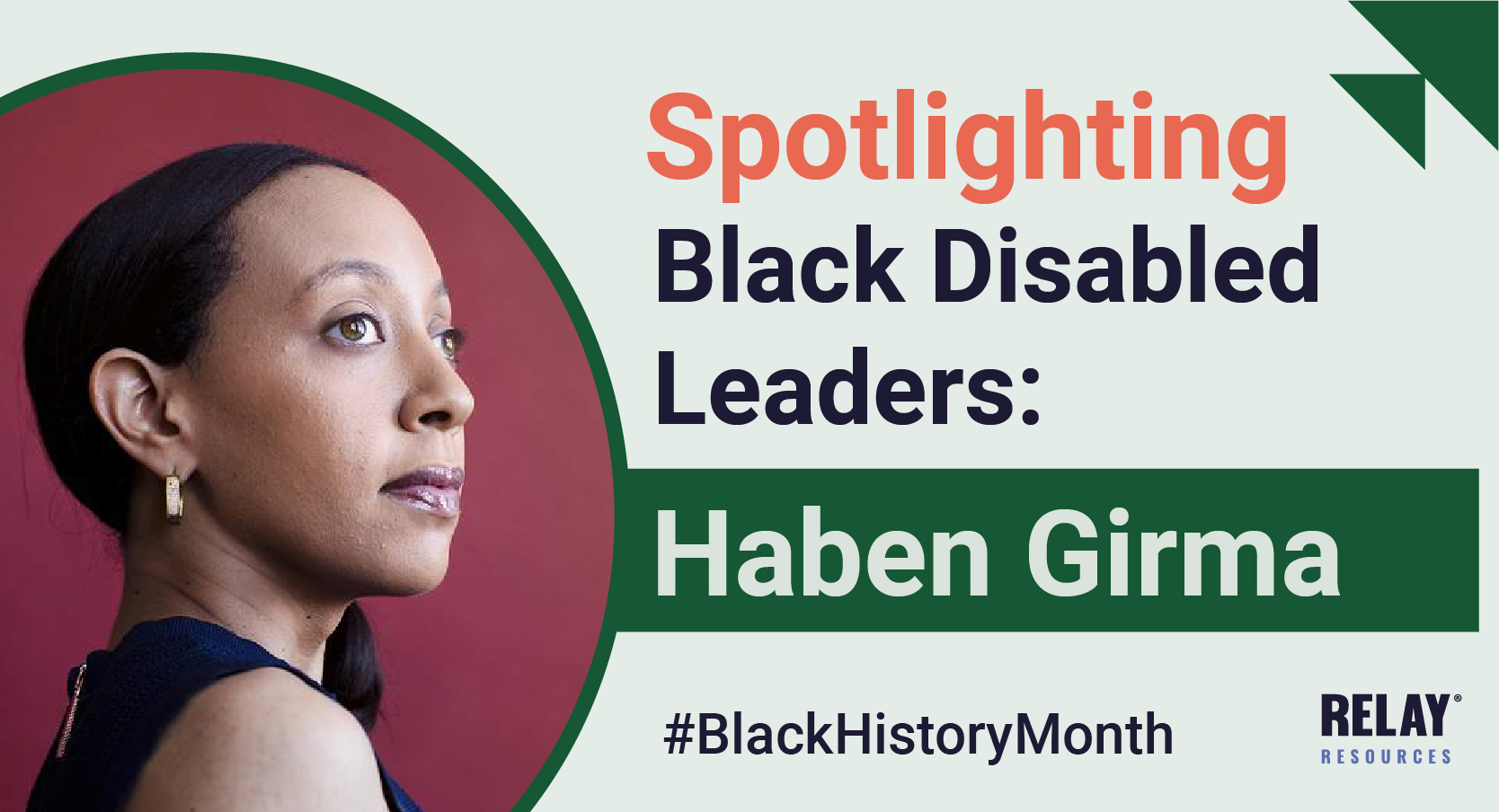
This week, we’re spotlighting Haben Girma, a 37-year-old disability rights attorney, writer, and public speaker who was the first deafblind person to graduate from Harvard Law School.

Much of Girma’s public speaking work—which has included talks at Oxford University, Apple, and Disney—centers around her advocacy for disability justice, which has earned her substantial recognition. President Barack Obama named her a White House “Champion of Change” in 2013, and in 2018 Book cover featuring a side-profile portrait of Haben Girma. Large title “Haben,” with the subtitle “The Deafblind Woman Who Conquered Harvard Law".she won the Helen Keller Achievement Award from the American Foundation for the Blind, honoring people and organizations that have helped improve the quality of life for disabled people.

In 2019 she published a book, Haben: The Deafblind Woman Who Conquered Harvard Law, telling her story of growing up disabled, using innovative methods to communicate and conquer challenges, and ultimately becoming a world-renowned disability rights advocate.

Developing Advocacy

Born in Oakland, Calif., to parents who immigrated to the U.S. from Eritrea, Girma was born deafblind, with residual hearing and vision as a child that enabled her to learn how to speak. She grew up using accessible technology such as digital braille readers, benefiting from civil rights laws for disabled people provided by the ADA.

While attending Lewis & Clark College—in Relay’s hometown of Portland, Ore.—Girma was unable to read the cafeteria menu that was only provided in print form. After her requests for a braille menu were rebuffed, she researched the issue and found that the ADA law legally required the university to provide her with a menu in Braille.

While this moment helped set her on the path to law school, Girma also saw the victory as meaningful to her community. “I think what really helps is to realize that when you stand up for yourself, you are not just helping yourself, you are helping other people,” she told Ability Magazine in 2019. “If you don’t do something, this barrier is going to continue.”

After graduating from Lewis & Clark in 2010, she entered Harvard Law School, using a guide dog and assistive technology—which she would later become an advocate for—to engage in coursework, and eventually earning her law degree in 2013.

Fighting for Inclusivity

Today, with her German Shepherd guide dog Mylo at her side, Girma advocates primarily for increasing digital accessibility, encouraging a more inclusive technological world that allows everyone—including the disability community—to participate.

Some of this advocacy involves encouraging the tech world to build inclusivity into their systems. As Girma told Ability, “When you design for accessibility, it makes your whole service better. When you add transcripts and captions to a video, more text is associated with the video, which leads to search engine optimization. More people will find your content through keyword searches. That makes your content easier to find for disabled and non-disabled people, which helps you, the media creator, grow your audience. And that is just one example.”

While doing her advocacy work, Girma also draws from her legal background. “The legal system is a last resort,” she told the Harvard Law Bulletin in 2013, saying that people often just need to be educated about how to make things accessible. “But if you get into a situation where someone is not willing to make something accessible,” she told HLB, “then the legal system is there to make sure that you’re treated as a full and equal person.”

Girma is also a strong proponent of including disabled people in the workplace—which is at the heart of Relay’s mission. She told legal technology company Clio in 2025, “When you live with a disability in a world filled with barriers, then you are forced to come up with new solutions so that you can have access to the environment. And those problem-solving skills are an asset to employers. So disabled people may have more innovation skills and problem-solving skills.”


Building a Disability-Inclusive Future

As we’ve explored this month, disabled leaders and their advocacy have made a substantial impact on our society, from getting laws changed to enable more inclusivity, to advocating on the biggest stages for disability rights. While Lois Curtis and Anita Cameron made powerful strides in the 20th century, activists like Girma are continuing this work in the present day—and setting an example for leaders of the future.

Relay Resources would not be able to do the work we do without the pioneering work of the people who have fought tirelessly for inclusion. Alongside disability champions like Girma, Relay works toward creating a future where all disabled people belong. Everywhere.

Our Location

5312 NE 148th Avenue
Portland, Oregon 97230

DIRECTIONS